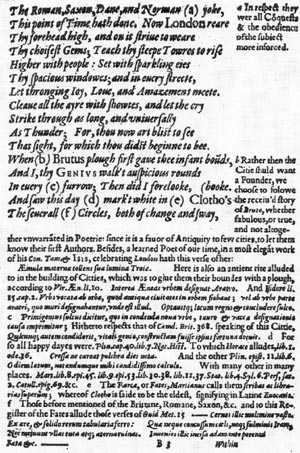
Ben Jonson, An Entertainment
In fact, there's evidence of one such shift in the late seventeenth century, when critics looked back just a short while and saw not a tick of the clock, but a turning of the calendar page. As the seventeenth century came to a close, readers came to sense that the age of Milton was an age apart. A chasm seemed to open between them and their predecessors of just a few decades before. In that separation, I argue, we can discern a larger cultural movement happening at that time: the division of epochs in which a new set of "moderns" looked back on their forerunners and proclaimed them part of the "last age." In this paper I'd like to examine a small but significant case-study in the development of a sense of a native English literary "classic."
My case study today is an edition of Paradise Lost, in which we can watch Milton's canonization and periodization as it happens. First the facts, which can be summarized in a few words. A folio edition of Paradise Lost, the sixth, was published by Tonson the elder in 1695; with it was bound Annotations on Paradise Lost, a work of 321 pages, attributed to "P.H., Philopoiêtês." P.H. was probably Patrick Hume, a Scot, otherwise unknown. But he deserves our attention, because he was the first systematic commentator on Paradise Lost — indeed, the first systematic commentator on any work in Modern English — and he produced his commentary a mere twenty-eight years after Paradise Lost was published.
Before addressing the specifics of Hume's annotations, I'd like to pause to reflect on the very existence of such a work. Why devote over three hundred folio pages to a poem not yet three decades old? Sure, Paradise Lost is difficult, but that had never been a good enough reason before. Such treatment had been reserved exclusively for the classics and the Bible: no one had ever subjected works hot off the presses to philological inquiry, not even Shakespeare or Spenser. We live in an age when there are over a hundred critical books on Toni Morrison, and the Library of Congress already has a subject heading for "Rowling, J. K. — History and Criticism." We're used to the "modern classic," but audiences in 1695 still felt the force of that oxymoron. No one had ever treated a work in Modern English as a classic before Hume; he was in fact the second person ever to use the word annotations in the title of an English work on a modern, secular text.1 And though Hume was more comfortable with antiquated language than my insurance-company coworker, he shared with her a sense that something from the comparatively recent past needed to be understood as the product of a lost age.
My argument depends on the proposition that full-dress classical treatment implies classical status, and I think Hume's exercise in annotation bears that out. By approaching Milton the way others had approached the Bible, Homer, or Virgil, Hume places him in their company, classicizing a poet only recently dead. In case that isn't clear, a title-page epigraph eliminates all ambiguity. He cites Juvenal's seventh satire, which reads, "Uni, cedit Homero/Propter Mille annos," "He yields to none but Homer, because of his thousand years." Juvenal is talking about a verse-writing patron, but Hume alters the lines: "Uni, cedit MILTONUS, Homero/Propter Mille annos," with "MILTONUS" in caps: "Milton yields to none but Homer."
|
|
Ben Jonson, An Entertainment |
 |
|
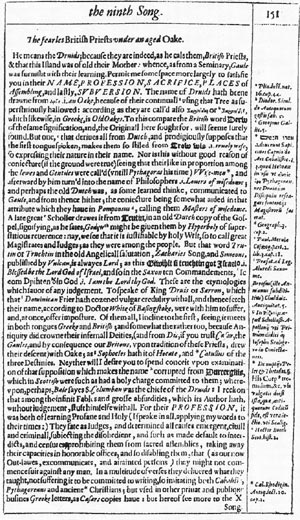
Selden, Annotations to Drayton |
Why, then, do I call P.H.'s Annotations new? Let's start with Speght's Chaucer. In 1598, nearly two centuries after his death, Chaucer was already a classic. The Italian humanists of the Quattrocento had provided sixteenth-century Englishmen with a historical divide — modern enlightenment on this side, medieval darkness on the other — and it took only minor adjustments to map it onto English history. Speght is therefore explicit: Chaucer is "this auncient Poet," whose work "is restored to his own Antiquitie."6 This is evident even in the typography of the edition: Speght's front matter and annotations are in roman type, but Chaucer's text is in black letter, a sure sign that it was "old English." The linguistic and cultural change was already evident to contemporaries.
E.K. approaches Spenser in a similar spirit by glossing the obsolete words. But the words were intentionally obsolete, and the commentary appeared with the pastorals on their first publication. An analogue might be Eliot's famous, or infamous, notes on The Waste Land, which served both to guide readers through his textual and allusive thickets and to show off the extent of his learning. But E.K. didn't make The Shepheardes Calender a classic: Spenser did. By assuming an antiquated voice, he associated his new text with an old tradition.
Drayton's Poly-Olbion makes no pretense to being an old work. Selden's commentary, which appeared on the work's first publication, is more extensive than E.K.'s or Speght's, but the question is what he is explicating: not an old poem, I argue, but a new poem on an old topic. The commentary is concerned with the history and chorography, not the poem; the annotations might just have well appeared in an edition of William Camden or Peter Heylyn. Poly-Olbion is merely an excuse for Selden to show off his erudition.
Both E.K. and Selden were annotating the works of friends, and any "classicization" can be written off as professional courtesy. And Ben Jonson was more than a friend of Ben Jonson. All recognized the classicizing effect of annotation, but none used it to create a new classic: the works either arrived pre-canonized, or were making self-promoting claims to a classic status they had not yet earned.
 |
|
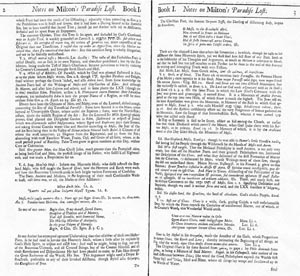
P.H., Annotations on Paradise Lost |
What sort of commentary does a comparatively recent epic demand? — in what contexts does Paradise Lost make sense? Of Hume's nine scrillion annotations, nearly all either gloss words or explain classical allusions. The philological notes range over Latin, Greek, Hebrew, French, Italian, German, and Saxon. Some are surprisingly simple, such as on words like triple, ponderous, and human. More interesting are the parallels in other works: in the first 500 lines of the first book, Hume explains fully 361 allusions, sources, and analogues. Just under half (167) are to the Bible, whether in Hebrew, the Vulgate, or the Septuagint. In second place are the classics of Rome, especially Virgil and Ovid. Greek literature comes in third with 41 references, followed by the Church Fathers with 17. Modern Italian and English works get eight each — Tasso for the former, and Spenser, Raleigh, and "the Learned Selden" for the latter. Eight allusions are to more obscure traditions, such as Cabala and Egyptian mystical writings. By comparison Merritt Hughes, editor of the standard twentieth-century Paradise Lost, glosses only fifty-eight allusions in the same five hundred lines: twenty-eight from the Bible, sixteen from the Greek and Roman classics, and fourteen from medieval and modern authors.7 Note how the balance has shifted. The modern editor gives 48 percent of his notes to the Bible, and Hume 46: no great difference. But in 1958 Hughes devoted 28 percent of his notes to the Greeks and Romans, and 24 percent to medieval and modern authors. In 1695, Hume has 47 percent from the Greek and Roman classics, less than 5 percent from modern authors, and not a single medieval work. This is doubtless owing in part to limitations in his education, but it also suggests that the ancient classics are where the money was. What we call the Renaissance was only beginning to become the "last age," and Hume had nothing to gain by contextualizing Milton among his contemporaries. Milton gets more bang for his buck from allusions to Homer and Virgil than he does to Ariosto or Shakespeare, whose status as classics wasn't yet clear.
I don't want to suggest that P.H. was the paradigm-shaking genius who opened the floodgates to later annotators: the classicizing of the English Renaissance was in the air, and if he hadn't gotten there first, someone else would have. It is going too far to call him the progenitor of modern scholars of English literature. But his work shows the dynamics of cultural periodization better than many others, because of the volume of his commentary, the great care he lavished on his poem, and the chronological proximity to the work he commented on. For Hume's project depends on the sense that an age has passed, and that Milton's works were not only great, not only difficult, but somehow alien, and that their greatness was explicable only by bridging the gap between Milton's age and Hume's. The otherwise anonymous P.H. was no genius, but he was the first to look on a Modern English work as classic worthy of serious study. For that reason he occupies a prominent place in the genealogy of all scholars of English literature.
2. The Works of Edmund Spenser: A Variorum Edition, ed. Edwin Greenlaw, Charles Grosvenor Osgood, and Frederick Morgan Padelford, 11 vols. (Baltimore: Johns Hopkins Univ. Press, 1932-57), 7:10.
3. Sig. Tttir.
4. "To the Readers" (n.p.).
5. Poly-Olbion, sig. A2r-v.
6. "To the Readers"; "Dedication" (both n.p.).
7. Of these, Hughes was anticipated by Hume about two thirds of the time. Hume spots twenty-five of Hughes's twenty-eight biblical, nearly ninety percent. His success rate is only slightly lower for the classics: of Hughes's sixteen, Hume spots about seventy-five percent of Hughes's allusions. On medieval and modern works, though, Hume shows a blind-spot. Hughes finds fourteen allusions to the works of Dante, Macchiavelli, Tasso, Caxton, Ariosto, and Shakespeare, of which Hume correctly identifies none, though he suggests several classical parallels for Ariosto's "Things unattempted yet in prose or rhyme."